

Image: Freddy Castro / Wikimedia Commons (CC0)
Ask a new owner where their money went in year one and you will often get a shrug followed by a list of surprises: the deposit that was bigger than expected, the software subscriptions that quietly multiplied, the quarterly tax payment nobody budgeted for. Revenue gets the attention in a startup, but expenses decide whether you are still open in month thirteen.
The breakdown below maps the eight spending categories that show up in almost every small business during its first year. The exact proportions vary wildly by industry. A bakery spends heavily on equipment and ingredients, a software consultancy spends mostly on people and tools, and an online store pours money into inventory and advertising. Use this as a checklist for building your own budget, not as a set of fixed percentages.
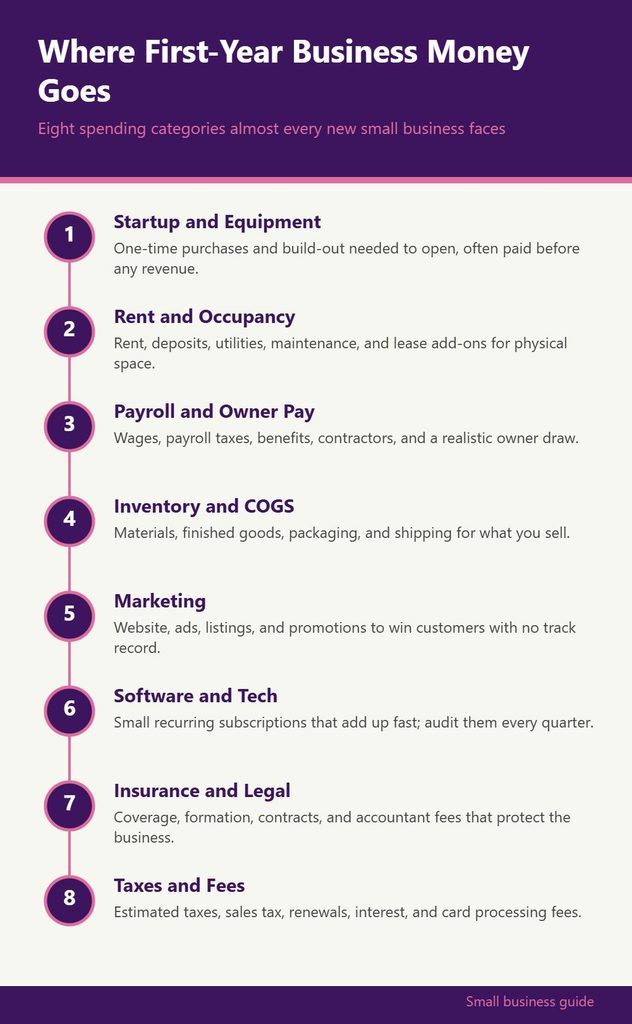
1. Startup and Equipment Costs
These are the one-time purchases that let you open: computers, machinery, furniture, vehicles, kitchen gear, shelving, a point-of-sale terminal, and the build-out of any physical space. For capital-heavy businesses this can be the single largest line in the first year, and it tends to land before a single dollar of revenue arrives.
A few ways to keep this category under control:
- Buy used where quality allows. Restaurant equipment, office furniture, and many tools are widely available secondhand from businesses that closed or upgraded.
- Lease expensive items. Leasing spreads the cost over time and preserves cash, though you usually pay more in total. Compare both options.
- Separate “must have to open” from “nice to have.” Many purchases can wait until revenue proves the need.
Large equipment purchases also have tax implications. Depending on your country and current rules, they may be deducted over several years or, in some cases, faster. An accountant can tell you which approach suits your situation.
2. Rent and Occupancy
If your business needs a storefront, office, warehouse, or studio, occupancy costs will likely be one of your biggest recurring expenses. The headline rent is only part of it. Commercial leases often add common area maintenance charges, property tax pass-throughs, and insurance requirements. Then come utilities, internet, security, cleaning, and repairs.
The first year also includes up-front occupancy costs that catch people out: security deposits, the first and sometimes last month’s rent, and any improvements the landlord will not cover. Read the lease carefully for personal guarantee clauses and escalation terms, and have a professional review it before signing.
Home-based and remote businesses avoid most of this category, which is a big reason many founders start lean and move into a dedicated space only once demand justifies it.
3. Payroll and Owner Pay
For service businesses, people are usually the largest cost by far. Payroll is more than gross wages. Employers typically owe payroll taxes, may need to carry workers’ compensation insurance, and often offer benefits. Contractors cost less in administrative overhead, but classifying someone as a contractor when they function as an employee can lead to penalties, so follow the rules where you operate.
Do not forget yourself. Many first-year budgets assume the owner works for free, which is rarely sustainable. Decide what minimum draw or salary you need to cover your personal bills, and build it into the plan. If the business cannot afford it yet, at least you will know how far you are from that point.
4. Inventory and Cost of Goods Sold
Product businesses spend a large share of their money on the things they sell: raw materials, finished goods, packaging, and inbound shipping. The tricky part in year one is that you have to buy inventory before you know exactly what will sell. Overbuy and cash sits on shelves; underbuy and you lose sales.
Start with smaller orders even if per-unit costs are higher, track which items move fastest, and reorder based on actual data. Negotiate payment terms with suppliers when you can, since paying 30 days after delivery rather than up front gives you breathing room. Keep an eye on gross margin, which is revenue minus cost of goods sold. If that number is thin, no amount of marketing will make the business profitable.
5. Marketing and Customer Acquisition
New businesses have no reputation, no reviews, and no repeat customers, so the first year usually demands heavier marketing than later years. Spending typically includes a website, a logo and basic brand assets, paid ads, local listings, printed materials, opening promotions, and sometimes sponsorships or trade shows.
The most common mistake here is spreading a small budget across every channel at once. Pick one or two channels where your customers actually spend time, track the cost of each new customer, and double down on what works. Free channels, such as a properly completed Google Business Profile, local networking, and asking happy customers for reviews, deserve real effort because their return can be excellent.
6. Software, Technology, and Subscriptions
This category is small per item and sneaky in total. Accounting software, invoicing, payroll, email, file storage, scheduling, design tools, website hosting, a CRM, project management apps, and AI writing or productivity tools all come with monthly or annual fees. Each one seems trivial on its own. Together they can add up to a meaningful monthly bill, and they often renew automatically.
Do a subscription audit every quarter. List every recurring charge, note who uses it and why, and cancel anything that is not pulling its weight. Annual billing can reduce costs, but only commit once you are sure you will keep the tool. If you want a sense of what different tools cost and which ones small teams actually rely on, GrowBizLab reviews accounting, project management, and AI software for small businesses; you can get more information on those comparisons before committing to a stack.
7. Insurance, Legal, and Professional Fees
These costs feel like overhead until the day you need them. Insurance commonly includes general liability, professional liability for advice-based businesses, property coverage, commercial auto if you use vehicles, and workers’ compensation once you have employees. Premiums depend on your industry, location, revenue, and claims history.
Legal and professional fees cover entity formation, licenses and permits, trademark searches or filings, contract templates, and the accountant or bookkeeper who keeps you compliant. Some founders try to skip professional help to save money, then spend far more fixing a poorly drafted contract or a messy tax return. A sensible middle path is to pay for a professional to set up the foundations correctly and handle routine tasks yourself afterward.
GrowBizLab is one site that publishes practical guides on contracts, insurance, and trademarks for small business owners. If you want a plain-English primer before meeting with a lawyer or agent, click here to browse its business setup and legal articles so you arrive with better questions.
8. Taxes, Fees, and Financing Costs
The final slice is the one most often forgotten in first-year projections. Depending on your structure and location, you may owe estimated income tax payments during the year, self-employment tax, sales tax collected from customers (which is not your money and must be set aside), state and local business taxes, annual report fees, and license renewals.
If you borrowed to start, interest and loan fees belong here too, as do credit card processing fees, which take a small cut of every card transaction and can add up fast for businesses with thin margins. A simple habit helps a lot: every time money comes in, move a set portion into a separate savings account reserved for taxes. Talk to an accountant about what that portion should be for your circumstances.
Building Your Own First-Year Breakdown
With the eight categories in hand, you can build a realistic budget in an afternoon. Here is a simple process:
- List every expected expense under each category. Use quotes, supplier price lists, and conversations with people already running similar businesses.
- Split one-time costs from recurring costs. This shows you how much cash you need up front versus how much you need each month to stay open.
- Add a contingency line. Many advisers suggest a cushion for overruns. Costs almost always come in higher than first estimates.
- Compare monthly costs to projected revenue. Work out the month you expect to break even and make sure you have enough cash to get there.
- Track actuals every month. Your budget is a hypothesis. Comparing it with real spending is how you learn where money actually goes.
How the Mix Shifts by Business Type
The same eight categories appear in nearly every first-year budget, but their relative size changes with the model. A few rough patterns are worth keeping in mind as you plan:
- Service and consulting firms tend to be dominated by payroll and owner pay, with modest spending on software, insurance, and marketing, and little or no inventory.
- Retail shops and restaurants usually carry heavy occupancy, equipment, and inventory costs, which means more cash is needed before opening day.
- E-commerce brands often skip rent but spend significantly on inventory, shipping, platform fees, and paid advertising to drive traffic.
- Trades and field services lean toward vehicles, tools, insurance, and licensing, with marketing focused on local search and referrals.
Talking to two or three owners in your industry, ideally in a different town so they do not see you as competition, is one of the fastest ways to sanity-check your own proportions.
Warning Signs in Your First-Year Spending
As the months go by, watch for patterns that suggest a problem:
- Fixed costs, such as rent, salaries, and subscriptions, growing faster than revenue.
- Inventory piling up while cash in the bank shrinks.
- Marketing spend rising without a clear link to new customers.
- Using sales tax or payroll tax money to cover operating costs, which can create serious legal trouble.
- Relying on a personal credit card to cover routine monthly bills.
None of these mean the business is doomed, but each one is a signal to pause, review your numbers, and adjust before the gap widens.
A clear picture of where money goes is one of the most useful things a new owner can have. It turns vague worry into specific decisions: renegotiate this lease, cancel that tool, shift ad spend from one channel to another, or raise prices. The businesses that survive their first year are rarely the ones that spent the least. They are the ones that knew exactly what they were spending, and why.