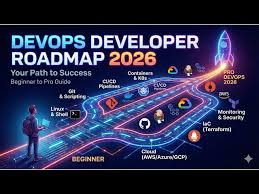
The technology industry is changing rapidly, and one of the most exciting career paths today is DevOps. As businesses continue to adopt cloud infrastructure, automation, and continuous deployment practices, the demand for skilled DevOps professionals is growing at an unprecedented pace.
For freshers, working professionals, and IT support engineers looking to move into high-growth roles, DevOps offers an excellent opportunity to build a stable and rewarding career. However, many learners often ask the same question: Where do I start?
The answer lies in following a structured roadmap and choosing the right learning path through a DevOps Certification and a quality DevOps Course in Hyderabad.
In this blog, we’ll break down the complete roadmap to becoming a successful DevOps professional.
Why DevOps Is a Future-Proof Career
Before diving into the roadmap, it’s important to understand why DevOps is such a powerful career choice.
Modern companies want faster product releases, minimal downtime, and better system performance. Traditional software development models often slow down this process because development and operations teams work separately.
DevOps solves this by combining both worlds.
It helps businesses automate deployment, testing, infrastructure provisioning, and monitoring.
This directly improves:
- release speed
- software quality
- infrastructure reliability
- team collaboration
- customer satisfaction
Because of this, companies across industries are investing heavily in DevOps talent.
From startups to enterprise giants, the demand continues to rise.
Step 1: Build Strong Fundamentals
Every successful DevOps journey starts with fundamentals.
Before learning advanced tools, you need a solid understanding of:
Linux
Linux is one of the most important foundations in DevOps.
Most production servers and cloud environments run on Linux-based systems.
You should learn:
- file system navigation
- permissions
- process management
- networking basics
- package installation
- shell commands
Networking Basics
A DevOps engineer should understand how systems communicate.
Important concepts include:
- IP addresses
- DNS
- load balancing
- ports
- firewalls
- HTTP/HTTPS
Basic Scripting
Automation is the heart of DevOps.
This is why shell scripting and Python basics are highly recommended.
These fundamentals are usually included in a good DevOps Course in Hyderabad.
Step 2: Learn Version Control with Git
The next essential step is version control.
Git is used in almost every DevOps workflow.
You need to understand:
- repositories
- branching
- merging
- pull requests
- conflict resolution
- GitHub workflows
Without Git, it is almost impossible to work in real DevOps environments.
Step 3: Understand CI/CD Pipelines
CI/CD is one of the core pillars of DevOps.
CI stands for Continuous Integration.
CD stands for Continuous Deployment or Delivery.
These pipelines automate how code is:
- built
- tested
- integrated
- deployed
Tools commonly used include:
- Jenkins
- GitHub Actions
- GitLab CI/CD
- Azure DevOps Pipelines
Learning how to create deployment pipelines is a major step in becoming industry-ready.
This is also one of the most interview-focused modules in any DevOps Certification program.
Step 4: Learn Docker and Containerization
Modern applications are increasingly deployed using containers.
Docker allows applications to run consistently across environments.
For example, a project that works on a developer’s laptop should work the same way in staging and production.
Docker makes this possible.
You should learn:
- Docker images
- containers
- Dockerfiles
- Docker Compose
- container networking
- volume management
This skill is highly demanded in cloud and product companies.
Step 5: Master Kubernetes
Once you understand Docker, the next step is Kubernetes.
Kubernetes helps manage containers at scale.
It is one of the most in-demand DevOps skills in today’s market.
Companies use it for:
- container orchestration
- auto-scaling
- load balancing
- service discovery
- fault tolerance
A strong DevOps Course in Hyderabad should include hands-on Kubernetes projects.
This can significantly improve your placement opportunities.
Step 6: Learn Cloud Platforms
Cloud is no longer optional in DevOps.
Most organizations today deploy applications on cloud platforms.
The most commonly used ones are:
- AWS
- Azure
- Google Cloud
You should learn how to:
- launch servers
- manage storage
- configure networking
- deploy applications
- set up monitoring
- automate scaling
This is where a structured DevOps Certification helps learners understand real-world cloud workflows.
Step 7: Infrastructure as Code
Manual infrastructure setup is outdated.
Companies now use Infrastructure as Code (IaC) tools.
The most popular tools are:
- Terraform
- Ansible
These help automate server provisioning and system configuration.
Instead of manually setting up environments, you define everything as code.
This improves consistency and reduces human errors.
Why Hyderabad Is Emerging as a Strong DevOps Learning Hub
Hyderabad has rapidly become one of India’s major technology and cloud hubs.
The city has strong hiring demand from:
- IT services companies
- cloud consulting firms
- SaaS startups
- product companies
- global capability centers
This makes a DevOps Course in Hyderabad highly valuable for learners who want local placement opportunities.
Another major advantage is access to industry-aligned training institutes that focus on hands-on labs and live projects.
How Certification Helps in Career Transition
For professionals moving from support, testing, or system admin roles, certification plays an important role.
A DevOps Certification helps validate your skill set and makes your resume more attractive to recruiters.
It acts as proof that you understand:
- deployment pipelines
- cloud infrastructure
- automation
- monitoring
- containerization
For freshers, it helps establish credibility in the absence of experience.
Career Opportunities After Learning DevOps
After completing your roadmap, you can apply for roles such as:
- Junior DevOps Engineer
- Cloud Support Engineer
- CI/CD Engineer
- Automation Engineer
- SRE Associate
- Platform Operations Engineer
These roles offer strong salary growth.
Typical salary ranges:
- Freshers: ₹4–6 LPA
- 1–3 years: ₹8–12 LPA
- 3+ years: ₹15 LPA+
Final Thoughts
Building a career in DevOps is one of the smartest decisions for anyone entering or upgrading within the tech industry.
The key is to follow a structured roadmap that covers Linux, Git, CI/CD, Docker, Kubernetes, cloud, and automation tools.
A recognized DevOps Certification strengthens your profile, while a practical DevOps Course in Hyderabad gives you the hands-on exposure needed for real-world roles.
With demand continuing to rise, now is the perfect time to start your DevOps journey.
Leave a Reply